

Four layers, built to work as one.
Each layer carries the one above it, from the infrastructure your data runs on to the applications your teams use.
- 4ApplicationsHubbiot AppsApplications on top of Heim for every part of the organisation, with more to come.Field InsightsEngineeringCommissioning & ChangeOperationsService ReadinessServiceFleet AttentionAftermarketInstalled BaseSalesAccessIT and security
- 3PlatformHubbiot HeimThe Digital Twin, with Knowledge and Hubbiot AI built in. As SaaS, in your cloud, on premises or hybrid.Integrationsconnectors to the systems you already runTwin processyour systems modelled into the twin by AIHubbiot AIEU sovereign answers and agents, on site with an AI Server
- 2DatabaseTvennDB by HubbiotThe graph database underneath Heim, also available on its own.Licenceself hosted, for productionSaaShosted by Hubbiot AB on HiveTvennDB Freefor development, evaluation and small companies
- 1InfrastructureHubbiot HiveThe European cloud Hubbiot runs on, also available as cloud services.Computecapacity on demand, in EuropeStoragedata kept in EuropeData Streamcontinuous data from machines and systemsEventschanges delivered the moment they happen
App names are working titles.
Value in every vertical.
Hubbiot Apps bring value to each part of the organisation, each drawing on what the others know, because they all read the same twin.
Field Insights
Which software and firmware versions, parts and settings, alone or combined, perform better or worse in the field.
Commissioning & Change
What each unit was built and commissioned as, and every change made to it since.
Service Readiness
The right fix the first time: what is installed, its history, the procedure and the parts before the visit.
Fleet Attention
Which units in the fleet need attention now, turned into uptime and parts revenue.
Installed Base
What every customer runs, where, and what is due: upgrades, renewals and replacements.
Access
What people, partners, AI agents and connected assets may see, do and receive, as rules that follow the asset.
Working titles. The five apps for the verticals are planned for the first release.
Identity that survives change.
A turbine today is not the same turbine it was five years ago, even with the same serial number. Components have been swapped, firmware upgraded, ownership transferred. Most platforms treat identity as a fixed label and lifecycle as an afterthought - so the twin drifts from physical reality within months of going live.
Hubbiot Heim treats identity, structure, lifecycle and lineage as first-class concepts. Models carry versions. Individuals carry their real composition. Every event is recorded as a fact in one graph, so the twin is always the asset as it is today - and as it was on any day before.
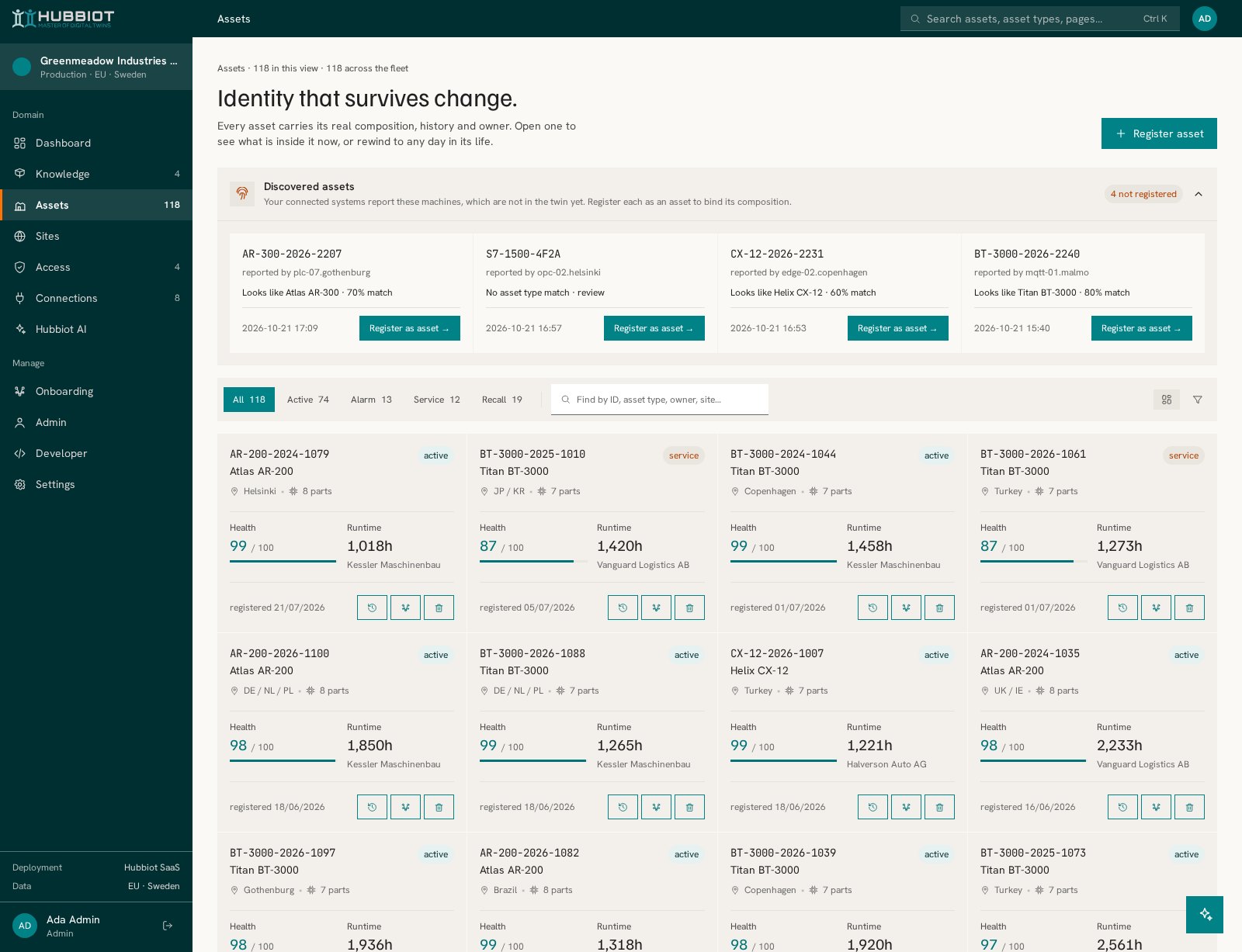
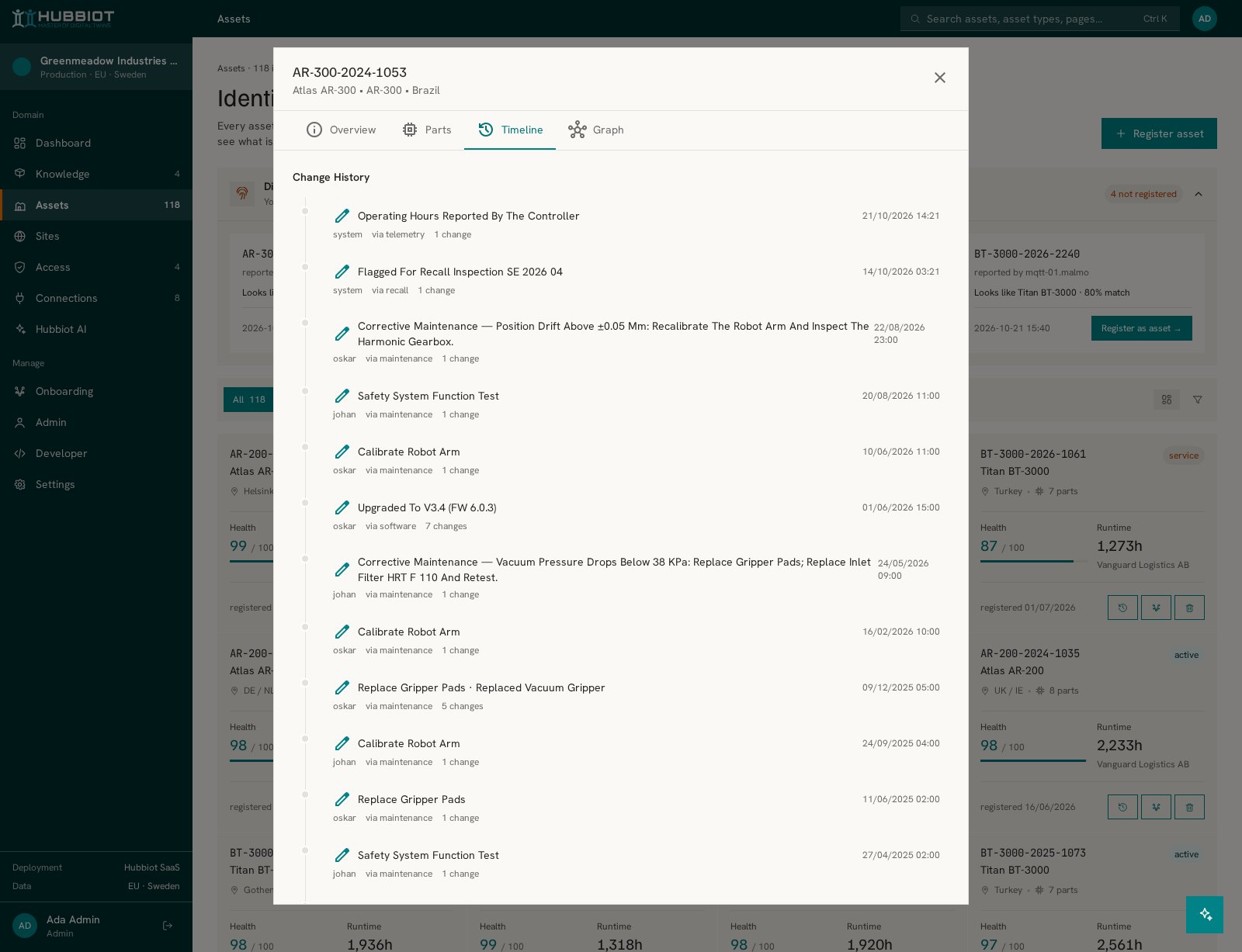
The data model: a three-tier hierarchy, instantiated into reality
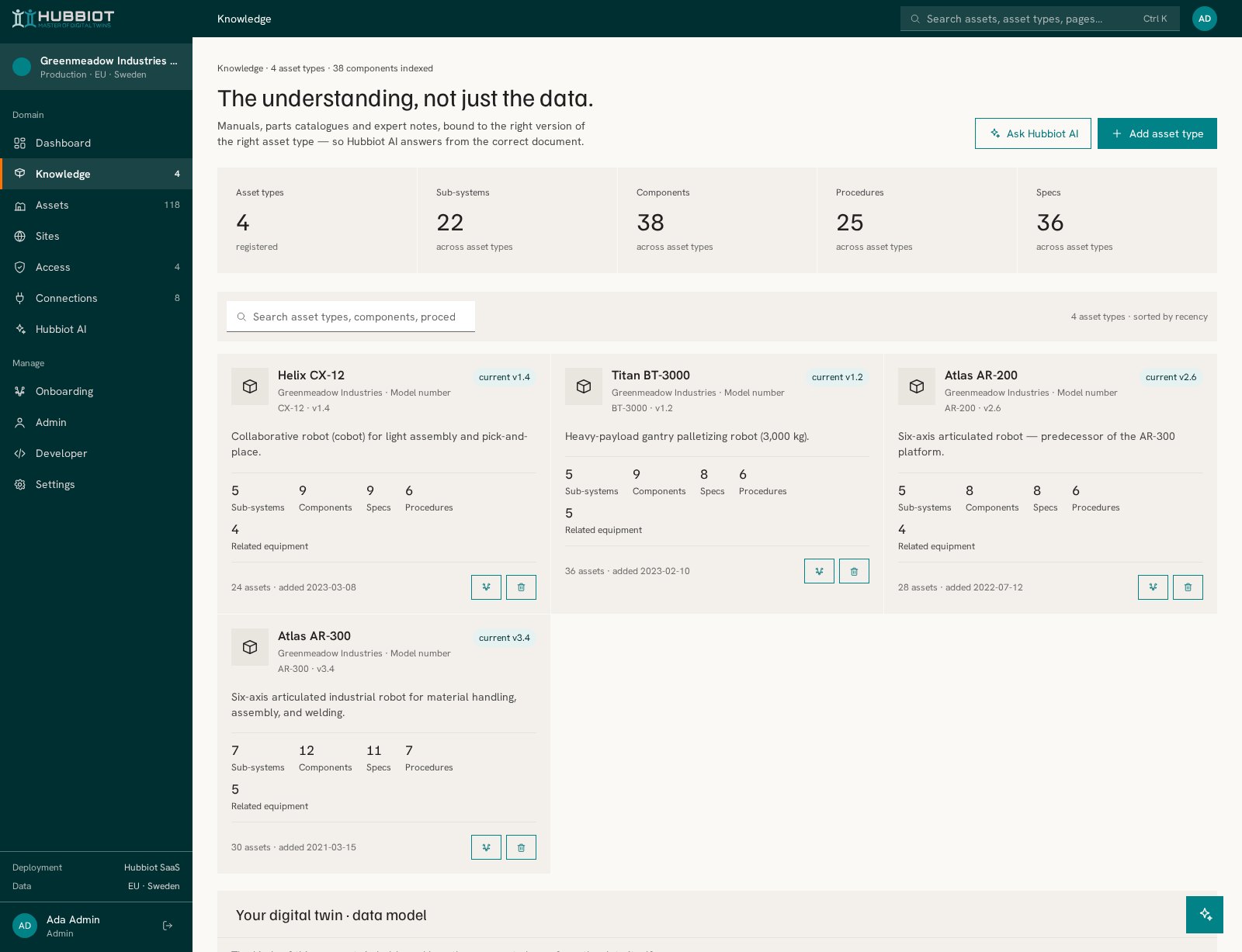
Asset Type
Define a product once and version it as engineering evolves - every unit ever built inherits a consistent, governed structure, so the whole product line stays coherent.
Product → SubSystem → Component
Asset Individual
Every machine carries its own true composition, history and owner - so you answer precisely for this exact unit in the field, not just the generic model.
SN-4471: Rotor · Sensor pack · Controller v2
Permission that follows the asset.
An asset crosses many organisations - manufacturer, dealer, operator, service partner, regulator. Each needs a different slice of the same record. Bolt-on permission models, built as lists of roles, turn brittle the moment that complexity is real.
The machine is sold. Does its history go with it? When the asset changes hands, the rule still holds, because it was written against the structure of the asset rather than the org chart.
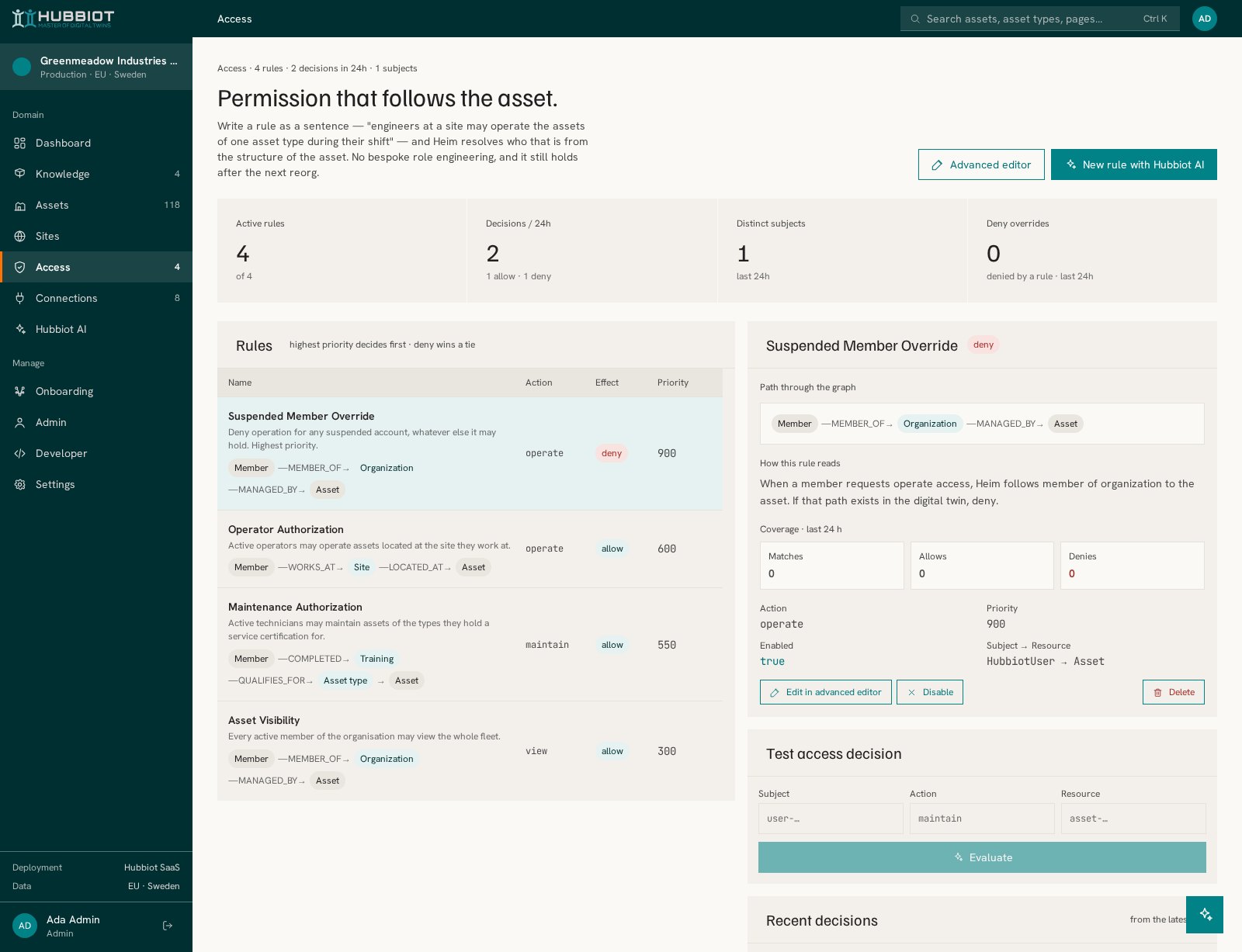
- Follows the structureA rule follows the structure of the asset: member → training → asset type → asset.
- Deny winsPriorities are explicit, and every decision is logged for audit.
- Test before liveSimulate a decision before it goes live - or draft the rule with Hubbiot AI.
- Every party, its sliceManufacturer, dealer, operator, service partner, regulator - each sees exactly what the asset structure grants them.
The understanding, not just the data.
Most platforms focus on data but ignore knowledge. Documentation scatters across systems and shared drives; expertise walks out the door when people leave. An assistant pointed at that pile answers confidently from the wrong manual.
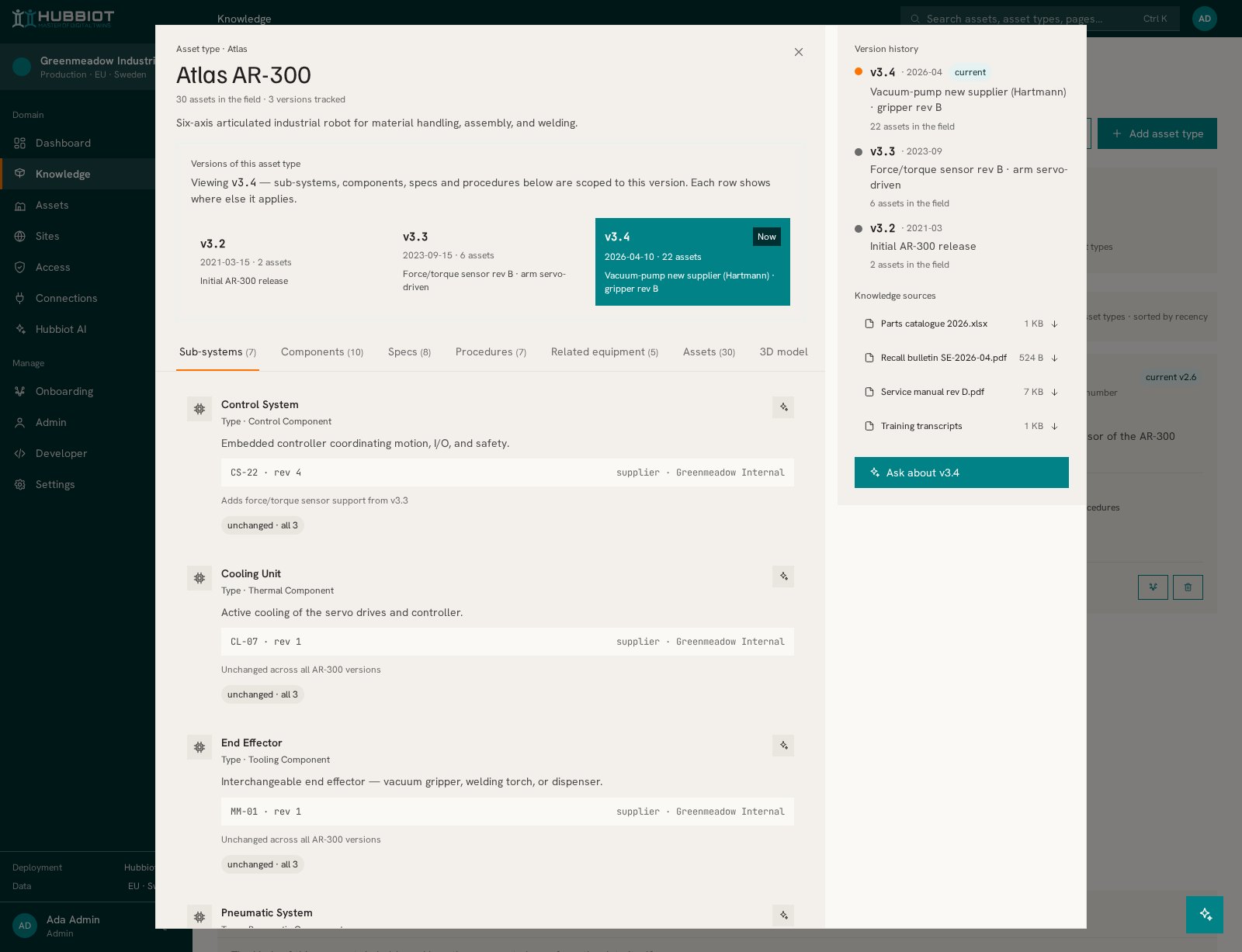
Manuals, specs and procedures are scoped to each version of each asset type - so Hubbiot AI answers from the correct document, and the expertise of a retiring engineer stays attached to the machine it describes.
Any view, any point in history.
Which units? Every recall starts as a search problem. TimeMachine reconstructs any individual, or the whole fleet, as it was at any moment, by reading recorded events and the periods they were in effect.
The history is in the data, never replayed. Ask about one machine on one day, or about the whole fleet across years.
- Commissioned
- Firmware v4
- Warranty claim
- Ownership change
- Now
- Which firmware was installed when the fault first appeared?
- What was inside this machine on the day of the warranty claim?
- Who owned it during the incident?
Fleet scale patterns
When the same behaviour emerges across many machines, Heim draws the pattern across the whole fleet, then rewinds to pinpoint the events that led up to it.
One traversal through the fleet, from the fault back to its cause.
Connect every system. Ask one question.
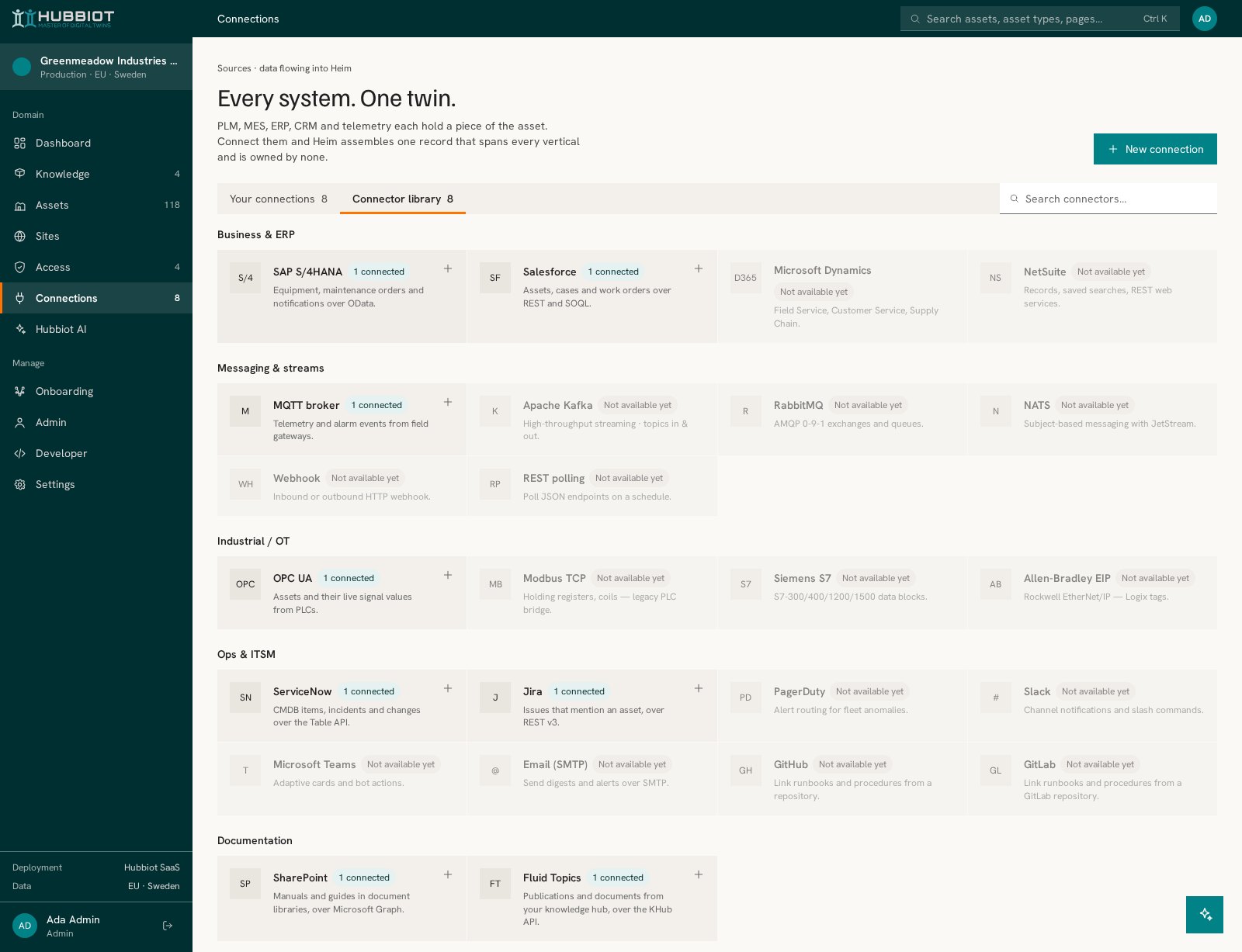
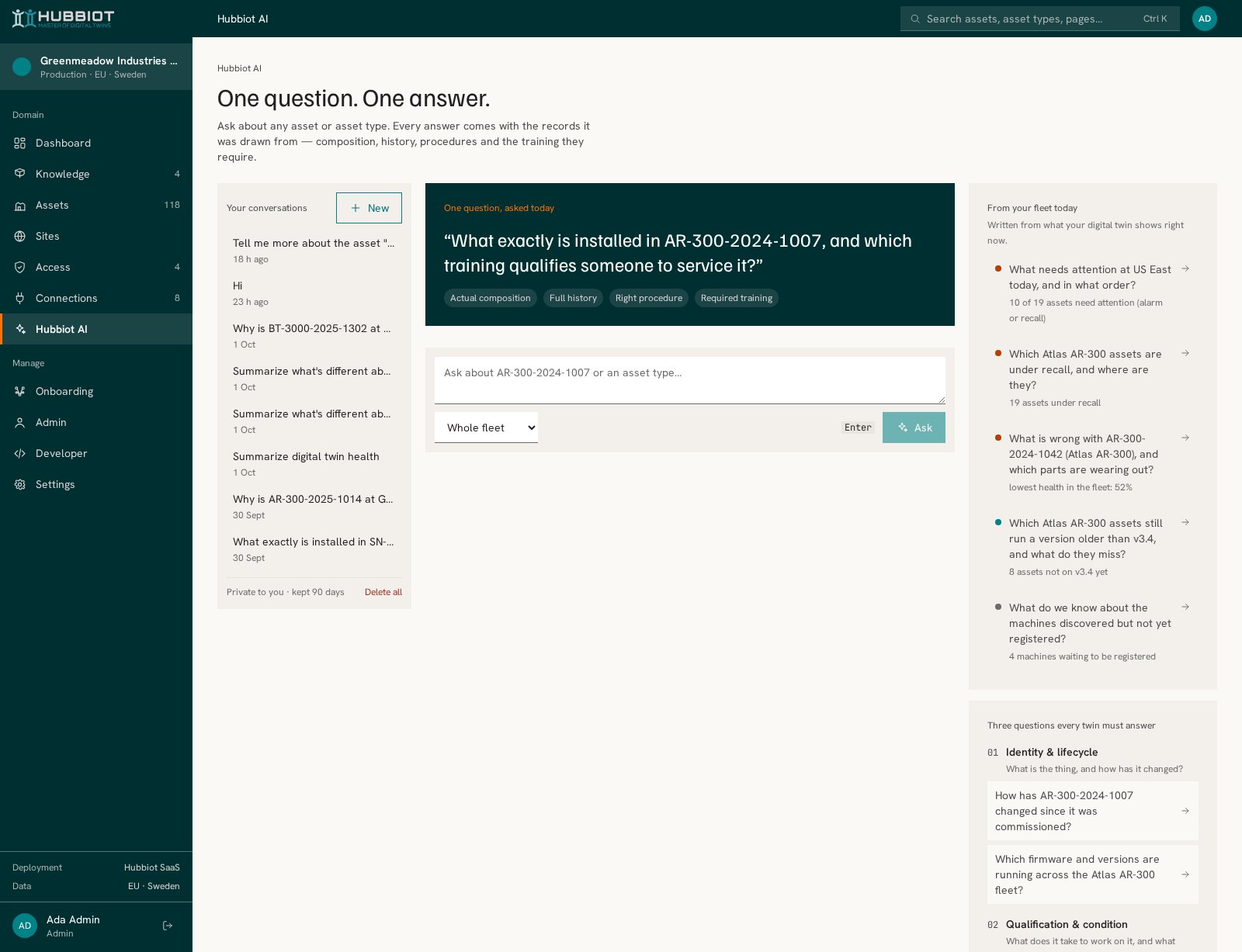
SAP, Salesforce, ServiceNow, Jira, OPC UA and MQTT feed one record - and every answer cites the records it came from. Hubbiot AI interprets the connected systems and documents and builds the twin; then it answers from it, grounded in the correct document for this exact machine. Fully EU-sovereign: models run inside your instance.
European. By architecture, not by address.
Same capability, wherever it runs. Sovereignty and portability are not features we plan to add later. They are architectural decisions made from day one. Your data lives on your own servers, in your own cloud, on our European infrastructure or a hybrid of them, never anywhere you did not choose.
On-premises
Maximum control and full sovereignty. Your data lives entirely on your own infrastructure and never leaves it. The platform runs on your hardware; Hubbiot delivers updates to it and nothing comes back.
Comes with its own dedicated AI Server, delivered configured and ready to use. Your AI runs on site, so neither your data nor your questions leave your infrastructure.
Suited to defence, aerospace and critical infrastructure - including fully air-gapped environments, where updates are delivered as signed bundles.
Customer cloud
AWS, Azure or GCP - runs inside your own accounts. Your data stays in your cloud, under your contracts and your regions, never sent to Hubbiot.
The right fit when a cloud strategy is already in place and the twin should sit next to the systems it connects to.
Hybrid
Some parts on your premises, others in Hubbiot SaaS, working as one twin.
Hubbiot AB maintains and monitors the on-site instances remotely, and your data never leaves your premises.
Hubbiot SaaS
Hosted and run by us on our own European infrastructure - a managed service without giving up sovereignty. No hyperscaler in the chain; our servers, in Europe, operated from Jönköping.
The fastest way to start, and the way most pilots begin.
On-premises, customer-cloud and hybrid data never leaves your infrastructure. Hubbiot AB monitors, maintains and updates every installation remotely through Fleet Manager, and never accesses your data. Fleet Manager receives operational telemetry only, never customer data, and you can see exactly what is sent. Fully sovereign on request: zero telemetry, offline licensing, updates you import yourself.
At rest and in transit, on every deployment option.
RBAC plus Access: permission that follows the structure of the asset, with deny-wins and explicit priorities.
Comprehensive logging of every decision and every change, with TimeMachine for forensic queries and retention windows.
Four rings around the asset. Each one harder to cross.
Apps and dashboards are cheap to generate with AI. A trusted record of every asset, shared by everyone who works on it, is not. At the core sits the governed record; around it, four properties that grow stronger with time.
History compounds
Every year adds configuration, events and knowledge per asset, so every answer gets better with time.
A neutral seat between companies
OEMs, operators, service partners and regulators share data with a neutral custodian - not with a rival's platform.
Sovereign by architecture
On our own European infrastructure or your own servers, from day one, not added later.
Wired into every AI agent
Your systems and AI agents read the same twin over APIs and MCP, so every new agent starts from the trusted record.
Where does your asset data live today - and who can reach it? Talk to us about your deployment constraints.